
Sunscreen in the workplace
Sunscreen is a product most of us associate with beach days and summer holidays. Yet the sun does not take a day off when you clock in, and neither does ultraviolet radiation. For anyone working outdoors, in a vehicle, near windows or around industrial processes, UV exposure is a daily occupational risk rather than a seasonal nuisance. This guide explains why sunscreen belongs in your working routine and how to build a sun protection policy that actually gets used.
UV radiation does not distinguish between the beach and the workplace
You do not need to be on a beach for UV rays to reach your skin. They pass through glass, reach you during breaks outside and accumulate during the commute. In the UK, UV levels are often high enough to cause damage between March and October, and outdoor workers routinely receive several times the UV dose of indoor staff.
There is also a less obvious risk: UVC radiation generated artificially by industrial processes such as arc welding, metal fabrication and some sterilisation equipment. Standard daylight sunscreens do not always cover UVC. If your workplace involves these processes, you need a product formulated for both solar and artificial UV.
Apply sunscreen to every exposed area: face, ears, neck, hands and forearms. These are the parts that suffer most in outdoor and workshop environments.
Health benefits of sun protection at work
Using sunscreen at work is not just about preventing premature ageing of the skin, although that is part of it. The serious argument is risk reduction. The British Association of Dermatologists and the Health and Safety Executive both highlight that repeated unprotected exposure to UVA and UVB is the main avoidable cause of skin cancer.
Beyond cancer risk, daily protection prevents:
- Sunburn that impairs concentration and comfort during shifts
- Premature wrinkles, pigmentation and loss of skin elasticity
- Painful cracking and irritation of skin already stressed by repeated hand washing, solvents or gloves
- Reactive skin conditions triggered or worsened by UV exposure
For businesses, the calculation is straightforward. Sun-related absence, reduced performance in hot conditions and long-term occupational skin disease all carry a cost that a dispensable sunscreen does not.
How to choose the right professional sunscreen
Not every product on a supermarket shelf is suitable for a workplace. When specifying sunscreen for a team, check these points:
- SPF 30 as a minimum. SPF 30 prolongs the skin's natural protection against UVB roughly thirty times. For all-day outdoor work, SPF 30 or 50 is the sensible baseline.
- Broad spectrum, UVA and UVB. Look for compliance with the European recommendation on UVA protection, expressed as a UVA/UVB ratio of at least one third of the SPF value.
- UVC coverage where relevant. If welding, arc processes or artificial UV sources are present, choose a product tested against UVC as well.
- Water and sweat resistance. Essential for anyone working outdoors, in hot conditions or doing physical work. Resistance tested to ISO 24444:2010 is a useful marker.
- No added perfume. Fragrance-free formulations are better tolerated by people with sensitive skin, and there is no reason to add a scent to a product designed for frequent reapplication.
- Fast absorption, non-greasy finish. If it leaves a film, people will not use it. A product that soaks in quickly does not compromise grip on hand tools.
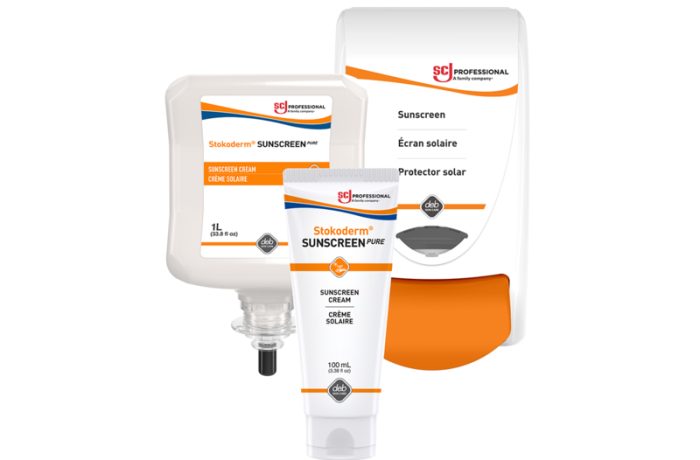
- A format that fits the workplace. Wall-mounted dispensers with 1 litre cartridges suit fixed sites and vehicles, while 100 ml tubes suit vans, belts and personal issue.
How to apply and reapply correctly
Application matters as much as the SPF number on the label.
- Apply generously to all exposed skin at least 30 minutes before going outside, so the product has time to form its protective film.
- Use roughly 15 to 20 ml for the whole body and about half a teaspoon for the face and neck alone. Most people apply far less than this, which is why real-world protection falls below the stated SPF.
- Reapply every two hours, and sooner if you have been sweating heavily, towel-drying or working in water.
- Do not skip overcast days. Cloud cover blocks some UV but by no means all of it.
- Remember that sunscreen complements protective clothing rather than replacing it. Long sleeves, neck protection, sunglasses and a brimmed or peaked hat do work sunscreen cannot, and vice versa.
- Consider UVA also when choosing PPE: no fabric offers infinite protection, and some clothing transmits more UV than people assume when it is worn, wet or stretched.
Sun protection in the workplace: a shared responsibility
Building a sun-safe culture at work is not one person's job. It is a shared responsibility between employers, employees and colleagues.
- Employers can assess UV exposure as part of their risk assessment, provide sunscreen and protective clothing, install dispensers where they are needed and schedule outdoor work to avoid the strongest sun, typically between 11am and 3pm in summer.
- Employees can apply sunscreen before starting, reapply through the shift and report skin changes that concern them.
- Colleagues and line managers can normalise it. A sunscreen dispenser placed next to the hand soap or on the way out to site is a permanent reminder, whereas a product locked in a stores cupboard is forgotten within a week.
Small practical signals make the biggest difference: a dispenser in visible places, briefings at the start of the outdoor season, and sun protection mentioned in the same breath as gloves and boots.
Is an employer in the UK legally required to provide sunscreen to workers?
UK health and safety law does not name sunscreen as a mandatory item in the way it names eye protection or safety footwear. The obligation sits in the general duty rather than in a specific clause.
The Health and Safety at Work etc. Act 1974 requires employers to ensure, so far as is reasonably practicable, the health, safety and welfare of their employees at work. Where UV exposure represents a genuine occupational risk, that duty covers it.
The Management of Health and Safety at Work Regulations 1999 require a suitable and sufficient risk assessment and, where risks are identified, the introduction of preventive and protective measures following the hierarchy of control. The Control of Substances Hazardous to Health Regulations 2002 govern hazardous substances and would capture chemical sunscreens used in industrial settings where relevant. The Personal Protective Equipment at Work Regulations 1992 require suitable PPE to be provided free of charge where risks cannot be controlled by other means.
In practice this means:
- Outdoor workers, including construction, agriculture, grounds maintenance, utilities, roadworks and delivery, carry a recognised UV risk.
- Employers should record that risk assessment, act on it and provide appropriate controls, which can reasonably include sunscreen as an adjunct to clothing and shade.
- Providing sunscreen is not a substitute for eliminating or reducing exposure in the first place, and it is not a substitute for PPE where PPE is required.
Stokoderm Sun Protect range
| Stokoderm Sun Protect 30 Pure SPF 30 broad spectrum sunscreen covering UVA, UVB and UVC. Perfume free, water resistant. Available in 100 ml tubes (box of 12) and 1 litre cartridges (box of 6). |
Stokoderm Sun Protect 50 Pure Higher SPF 50 protection for prolonged outdoor exposure. Perfume free, fast absorbing, non-greasy, with UVA, UVB and UVC coverage. |
Deb Stoko Sun Protect 1000 dispenser Wall-mounted dispenser for 1 litre Sun Protect cartridges. One dispenser serves a washroom, a changing area or a site exit point. |
Why choose Stokoderm Sun Protect from SC Johnson Professional?
Stokoderm Sun Protect is a professional sunscreen range from SC Johnson Professional, developed specifically for use in workplaces, industrial environments and schools rather than for holiday use. Key characteristics worth weighing when specifying a sunscreen for a team:
- Broad spectrum protection. Protects against both UVA and UVB, helping to prevent sunburn, premature ageing and skin cancer. The Sun Protect 30 Pure formulation also covers UVC, which matters for welding and industrial UV sources.
- Water and sweat resistant. Stays on the skin for longer periods even in demanding conditions, so a single application holds up through a working shift rather than a gentle afternoon.
- Perfume free and suitable for sensitive skin. No added fragrance, which reduces the risk of irritation for workers who already expose their hands and skin to soaps, solvents and gloves.
- Fast absorption, no greasy residue. Applies easily and absorbs quickly, without affecting grip on hand tools. This is what separates a product people actually use from one that stays in the van.
- Formats designed for the workplace. Available in 100 ml tubes for personal issue and 1 litre cartridges for wall-mounted dispensers, which makes refilling part of the routine instead of a chore.
- Established professional manufacturer. SC Johnson Professional is a recognised supplier in hygiene and skin care for industry, with the documentation and quality assurance standards that professional procurement expects.
- Social and environmental responsibility. Sustainability commitments on ingredients and packaging are increasingly part of procurement criteria and can be factored into supplier selection.
More technical information
Stokoderm Sun Protect is a high-performance sunscreen designed specifically for use in professional and educational settings. The technical points that underpin its effectiveness and safety:
- Regulatory compliance. Complies with European Cosmetics Regulation EC No. 1223/2009, as amended, which governs the safety and quality of cosmetic products placed on the European market.
- Safety data sheets. Available from the SC Johnson Professional website (www.scjp.com/msds), covering safety, environmental information, handling, first aid and disposal.
- Shelf life. At least 30 months from the date of manufacture when stored unopened at room temperature.
- Quality assurance. Manufactured in facilities compliant with Good Manufacturing Practice for cosmetic products (cGMP), with rigorous controls and testing on raw materials and finished goods before distribution.
- Product safety. Evaluated by independent toxicologists and shown to be safe for use on the body and face of adults and children over six months. Independent dermatological testing in volunteers confirms the product does not irritate the skin.
- Ingredients. Contains active ingredients including octocrylene, homosalate and butyl methoxydibenzoylmethane, which deliver UVA and UVB protection, alongside additional ingredients that improve texture, stability and ease of application.
- Formats. Supplied as 100 ml tubes and 1 litre cartridges, which allows the same product to serve personal issue and dispenser-based provision.
- Compatibility and efficacy testing. Tested for compatibility with rubber production processes and shown to be effective against UVA, UVB and UVC. Water resistance confirmed in line with ISO 24444:2010.
Remember that no sunscreen, including Stokoderm Sun Protect, provides total protection. It should be used alongside appropriate protective clothing, shade and scheduling, not instead of them.
Setting up sunscreen provision in your workplace
If you are introducing sun protection for a team, the practical version looks like this:
- Add UV exposure to the risk assessment and note which roles are affected and for how long.
- Choose a sunscreen matched to the actual exposure: SPF 30 or above, broad spectrum, water resistant, perfume free, and UVC protection where industrial UV sources are present.
- Install wall-mounted dispensers in places workers already pass through, such as washrooms, changing areas and site exits, and refill them with 1 litre cartridges.
- Issue personal 100 ml tubes for vehicles, tool bags and lone workers.
- Brief the team at the start of the sun season and include sun protection in the same conversation as gloves, boots and site rules.
- Review it each season rather than treating it as a one-off purchase.
Frequently asked questions
What SPF do outdoor workers need?
SPF 30 is the sensible minimum for working outdoors, with SPF 50 for prolonged exposure in strong sun. The number matters less than applying enough product and reapplying every two hours.
Does regular sunscreen protect against industrial UV radiation?
Only if the formulation covers UVC. Standard sunscreens are tested for UVA and UVB. If your processes involve arc welding, artificial UV sources or similar, specify a product tested against UVC, such as Stokoderm Sun Protect 30 Pure.
Can I use sunscreen together with gloves?
Yes, and it is often advisable. Apply sunscreen and allow it to absorb fully before putting gloves on for long shifts. Check that both products are compatible on skin prone to irritation, and remove gloves regularly so the protective film is not compromised by trapped moisture.
How much sunscreen should be available per person?
Plan on roughly 15 to 20 ml per application for exposed skin, which means around 30 to 40 ml per worker per day where reapplication is needed. A single 100 ml tube is not a full day of protection for a worker in the sun all day.
Is sunscreen still needed in winter or on cloudy days?
On cloudy days UV still reaches the ground, and in the UK UV can be significant from spring through autumn. If workers are outdoors for long periods, protection during the sun season is the priority, with cold weather and high altitude exposure also worth reviewing.
Does sunscreen interfere with grip or dexterity?
Not with the right product. A perfumed, heavy cream leaves a film that compromises grip on handles and tools. A fast-absorbing, non-greasy formulation such as Stokoderm Sun Protect is specifically designed to avoid this.
Share this content