
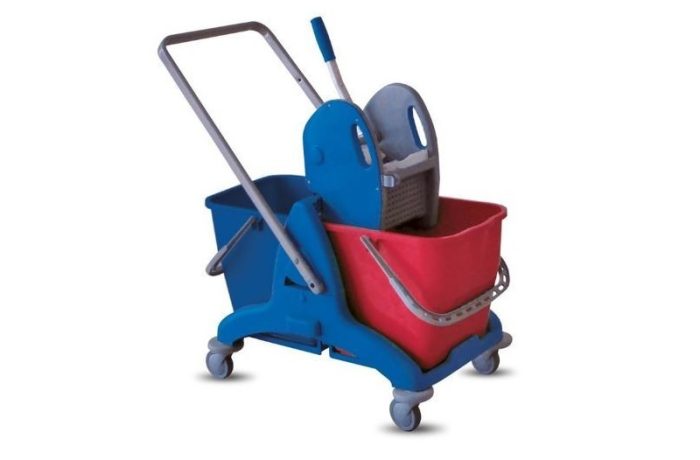
How to mop floors with a double-bucket cart
In professional cleaning, mopping is not a small task. It is one of the jobs that consumes the most labour hours, water and chemical product every week. A double-bucket mop cart looks simple, but it changes the whole method: clean solution stays separate from dirty rinse water, the mop releases less soil back onto the floor and the operative can cover more metres with fewer water changes.
This guide explains how to use a double-bucket system correctly, when it is worth buying one, which mop and handle to pair it with, and how to avoid the common mistakes that make a clean floor look dull, slippery or badly rinsed.
What a double-bucket mop cart does
A double-bucket cart separates two liquids that should never be mixed in a professional routine:
- Clean solution: water dosed with the correct floor cleaner.
- Dirty rinse water: the liquid removed from the mop after it has collected soil, detergent residue and organic load.
With a single bucket, the mop goes back into the same water again and again. The first metres may be clean; the last metres are often being washed with a grey solution. With two buckets, the wringer drains the dirty water into a separate compartment, so the working solution remains useful for longer.
Why this matters in a professional building
In an office, clinic, school, workshop, restaurant or residential building, floor cleaning is measured by three things: visual finish, hygiene and time. The double-bucket method helps with all three.
It improves visual finish because the mop does not spread dirty water across the final passes. It improves hygiene because soil is physically removed instead of diluted and moved around. And it improves productivity because the operative does not need to replace the whole bucket as often.
The economic difference is not dramatic on one small room. It becomes obvious when a team mops corridors, dining areas, entrances and toilets every day. Fewer water changes, fewer repeat passes and less chemical waste add up quickly.
Double bucket versus single bucket
Single bucket
A single bucket can work for very small areas, low soil loads or domestic use. Its limit is simple: the water gets dirty fast. Once that happens, the mop stops cleaning properly and starts redistributing residue.
Double bucket
A professional bucket system with two compartments is better for recurring work. It keeps the method controlled and makes supervision easier: one bucket for solution, one for dirty water, one wringer, one repeated process.
When to move to a larger cleaning trolley
If the operator also needs cloths, rubbish bags, paper, sprays and replacement mops, a full cleaning trolley may be more efficient than a simple double-bucket cart. The bucket system solves floor washing; a trolley solves the whole route.
How to prepare the cart
- Check the floor type. Ceramic, terrazzo, vinyl, rubber, laminate and polished stone do not all tolerate the same amount of water or alkalinity.
- Dose the detergent first. Use the dilution recommended by the manufacturer. More product rarely means a cleaner floor; it often leaves sticky residue.
- Fill the clean bucket. Use enough water for the route, but do not overload the cart. A heavy cart is slower and more tiring to move.
- Leave the dirty bucket ready. This bucket receives the liquid extracted by the wringer.
- Fit the mop and handle correctly. The mop head must be firmly fixed to the clamp and the handle must be comfortable for the operator's height.
The correct mopping sequence
The method is more important than the cart itself. A double bucket used badly becomes an expensive single bucket.
- Dip the mop into the clean solution.
- Wring it until it is wet enough to clean but not dripping.
- Mop a controlled section, working backwards from the farthest point towards the exit.
- Place the mop in the wringer and press the dirty water into the dirty bucket.
- Dip the mop again into the clean solution only after it has been wrung out.
- Change the clean solution when it loses clarity or stops giving a consistent result.
For safety, the floor should be damp, not flooded. Excess water increases drying time, slip risk and damage on sensitive surfaces.
The wringer is not an accessory
The wringer controls how much liquid reaches the floor. Too much water leaves streaks, puddles and slippery areas. Too little water forces the operative to scrub harder and may not dissolve the soil.
For daily maintenance, the mop should come out evenly damp. For heavier soil, it may need more solution on the first pass and stronger wringing on the recovery pass. The objective is not to leave the floor wet; the objective is to remove soil and leave the surface drying quickly.
Choosing the right mop
The cart is only half of the system. The mop decides absorption, glide, release of dirt and final finish.
Cotton mops
A cotton industrial mop absorbs a lot of liquid and works well on robust floors with higher water tolerance. It is a practical choice for traditional maintenance, entrances and large washable areas.
Microfibre mops
Microfibre captures fine dirt better and often needs less chemical product. It is useful where the expected finish is more demanding, such as offices, showrooms, clinics and retail spaces.
Mop clamps and handles
A good mop clamp prevents the head from moving while the operator works. A reinforced handle reduces bending, wrist strain and replacement cost. Cheap handles are rarely cheap if they bend, loosen or force bad posture during a full shift.
Which detergent to use
For most daily work, a neutral or slightly alkaline floor cleaner is enough. Greasy kitchens, workshops and loading areas may require a stronger product, but the decision should come from the type of soil, not from habit.
Two rules keep the process under control:
- Respect dilution. Overdosing wastes product and leaves residue that attracts more dirt.
- Do not mix chemicals in the bucket. It is unsafe, unpredictable and usually worse for the floor.
If the floor is delicate, test in a hidden area before applying the solution to the full route.
How to reduce cost per cleaned metre
The purchase price of the cart is not the main cost. Labour time, water changes, detergent waste, mop replacement and repeat cleaning are usually more important.
A double-bucket method reduces cost when it does four things well: keeps the solution cleaner, avoids unnecessary rinsing, shortens the route and gives a result that does not need a second pass. That is why professional buyers should compare the whole system, not just the bucket.
For a realistic calculation, estimate the metres cleaned per shift, the average number of water changes, detergent used per bucket and the useful life of the mop heads. This gives a much clearer figure than the price of the cart on its own.
Common mistakes
- Using one bucket for everything: it turns cleaning into dilution and redistribution.
- Overfilling the cart: it slows the operative and increases spill risk.
- Overdosing floor cleaner: it leaves residue and makes the floor attract dirt faster.
- Skipping dry soil removal: dust and grit should be swept or dust-mopped before wet mopping.
- Using the same mop in toilets and general areas: colour coding exists to avoid cross-contamination.
- Leaving the mop soaked after the shift: it smells, degrades and contaminates the next service.
Where a double-bucket cart makes most sense
The system is especially useful in buildings with repeated wet cleaning and medium or large floor areas:
- Communities of property owners and residential blocks.
- Restaurants, bars and catering areas.
- Schools, nurseries and training centres.
- Clinics, dental practices and care facilities.
- Gyms, sports centres and changing rooms.
- Warehouses, workshops and industrial units.
In all these cases, the benefit is the same: a repeatable method that a team can follow every day.
What to buy with the cart
A practical floor-cleaning set normally includes the cart, a compatible wringer, at least two mop heads, a clamp, a reinforced handle and the right detergent for the floor. Depending on the site, it may also need dust mops, warning signs and colour-coded equipment.
In LimpialoTodo.com you can combine double-bucket mop carts, industrial mops, flat mops and professional floor detergents in the same order. For recurring purchasing, check how to buy, delivery conditions and secure payment.
FAQ
Is a double-bucket mop cart more hygienic?
Yes, when it is used correctly. It keeps clean solution separate from dirty rinse water, so the mop does not return all the collected soil to the working bucket.
Can I use a double-bucket cart on laminate floors?
Only with strong wringing and a suitable neutral cleaner. Laminate and floating floors should never be flooded because water can enter joints and edges.
How often should I change the clean water?
Change it when it becomes visibly dirty, loses cleaning power or starts leaving marks. The exact frequency depends on traffic, soil load and detergent dilution.
Which mop is best for daily maintenance?
Microfibre is usually the most efficient option for fine dirt and controlled moisture. Cotton remains useful on robust floors that tolerate more water.
Does more detergent clean better?
No. Excess detergent leaves residue, increases rinsing work and can make the floor look worse after drying. Correct dilution is cheaper and usually cleaner.
Should the same mop be used everywhere?
No. Use colour coding and separate mops for toilets, kitchens and general areas. This is a basic control for professional hygiene and cross-contamination.
Share this content