
How to choose industrial toilet paper: a professional buying guide
How to choose industrial toilet paper without overpaying
This guide is written for anyone buying toilet paper for a site with real footfall: offices, hotels, restaurants, schools, gyms, care homes and residential blocks. Domestic toilet paper is off the table from the start, because neither the format nor the price per metre makes sense once consumption is measured in cases. The real decision turns on four variables that are almost never compared together: the raw material, the usable metres per roll, the dispensing system and the cost per 25 metres.
Most purchases are made by looking only at the price of the case. That is the most expensive mistake in this category, because the cheap case usually carries fewer metres and comes with a dispensing system that multiplies consumption. Let us put numbers on it.
Virgin pulp or recycled tissue: what actually changes
Virgin pulp toilet paper is made from fresh wood pulp that has not been processed before. It is new material, obtained directly from timber through a chemical and mechanical process. It involves felling trees and intensive use of resources, which is why it is considered less sustainable than recycled. In exchange it offers more softness, more wet strength and fewer breaks inside the dispenser.
Recycled toilet paper, also labelled eco, is made from recovered paper. It cuts felling and resource consumption significantly, and in most buildings it performs just as well. It can be slightly less soft and slightly less strong than virgin pulp, but with the right dispenser the user never notices. It is the option with the best balance between cost, environmental impact and brand perception as a responsible buyer.
One fact that does matter in a tender or a sustainability report: recycled paper carrying the EU Ecolabel has been verified by an independent competent body, not self-declared by the manufacturer. If you have to justify a green purchase, ask for the licence number, not a photo of the packaging.
You can see the available models in the professional toilet paper category, within personal hygiene.
How to work out which toilet paper is genuinely cheaper
Comparing cases by purchase price tells you nothing. Five factors decide the annual spend:
- Paper quality. Wet strength and behaviour in the dispenser. Paper that tears creates jams, refills and complaints.
- Number of plies. Two-ply is the professional market standard. A single ply lowers the unit cost but forces more paper per visit.
- Price per 25 metres. The real comparison unit. Take the case price, divide by the number of rolls, divide that by the metres per roll, then multiply by 25.
- Metres per roll and refill frequency. More metres per roll means fewer changes for the cleaner, less cardboard waste and lower labour cost. That saving does not show on the paper invoice, but it shows on the payroll one.
- Type of dispensing. Conventional (the user pulls until it tears) or controlled centre-pull, which in high-traffic sites cuts consumption by roughly 30%, with the trade-offs covered below.
Worked example with three real cases
The three cases below are calculated with the same method, using real products from the catalogue: Ecolabel industrial toilet paper (18 rolls), the Eco centre-pull industrial toilet paper (190 m, 12 rolls) and Full Tech paper in 24-roll cases.
- Standard industrial toilet paper (18-roll case, 100 metres per roll). The case costs €17.26. Per roll: €0.96. Per 25 metres: €0.24. Conventional dispensing, the user tears as much as they like.
- Full Tech toilet paper (24-roll case, 100 metres per roll). Same calculation: €0.36 per 25 metres. The roll has no cardboard core, so that waste disappears, no plastic is used in the packaging, transport is used more efficiently, and each refill can leave up to 200 usable metres of paper, which lowers the change frequency.
- Centre-pull toilet paper (case of 190-metre rolls). The case costs €39.34. Per 25 metres: €0.43. In return, the system prevents jams and cuts consumption by around 30%, which in high-traffic washrooms more than covers the difference per metre.
- The conclusion of the calculation: the cheapest case per 25 metres is not the cheapest option for the building if it drives more refills or more consumption. And the most expensive per metre can be the cheapest over a year if the dispenser controls usage. Sort the comparison by the annual cost of the building, not by the price of the case.
What controlled dispensing of toilet paper actually is
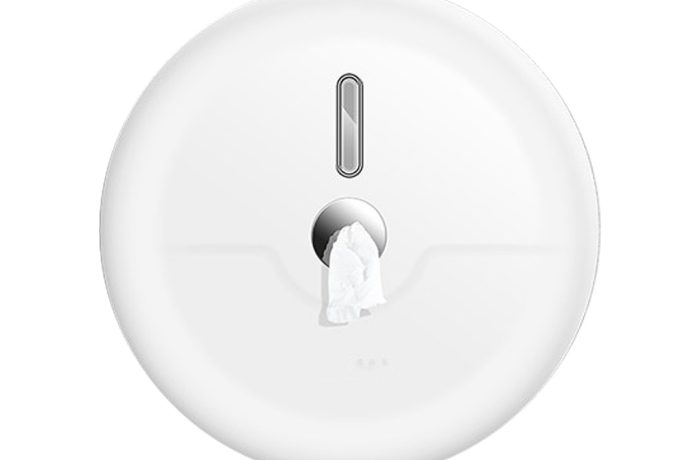
It is a delivery system that limits how much paper can be dispensed per use. The roll sits in a dispenser with a restricted opening, so the user only gets one sheet, or a limited number of sheets, at a time. It is used in office, restaurant, hotel and airport washrooms because it reduces waste and keeps the washroom tidier. For site management it is also a direct saving lever, since it stops a single user from pulling out a disproportionate amount of paper.
If you are going to install this system, look at the toilet paper dispensers and the dispensers and dosing units.

Advantages and drawbacks of controlled dispensing
Advantages
- Less waste: by limiting paper per visit, total consumption falls and so does the annual cost of the building.
- Better hygiene: less manual contact with the paper, which is critical in public washrooms and in healthcare or food-handling environments.
- More efficient staff: fewer refills per shift, less time spent changing rolls and unjamming dispensers.
- More predictable cost per visit: consumption stops depending on each user's judgement and can be budgeted per washroom and per month.
Drawbacks
- Upfront investment: you have to buy specific dispensers before the saving begins.
- Format lock-in: each dispenser takes one specific type of paper, which limits changing brand or reference.
- Poorer perception for some users: getting less paper per pull is experienced as an inconvenience, especially in customer-facing washrooms.
- Jam risk if the wrong paper is used: putting a roll of another size or another strength in turns the saving into call-outs.
Buying mistakes that cost money all year
- Buying on case price. The cheap case usually has fewer metres per roll and pushes up the annual cost.
- Not separating systems within the same building. Each format needs its own dispenser and its own stock. Within one site you standardise; across several sites you document which reference goes where.
- Ignoring the refill cost. Fewer metres per roll means more cleaner time and more cardboard waste.
- Forgetting the dispenser when budgeting. The paper is cheap; the equipment that controls it is what holds the saving in place.
- Choosing on softness for high-traffic sites. In a public washroom the priorities are strength and dispenser behaviour, not feel.
What to ask your supplier before deciding
- Price per 25 metres, calculated, not just the case price.
- Actual metres per roll and number of rolls per case.
- Number of plies and wet strength.
- Compatible dispensing type and whether the dispenser has a control system.
- Ecolabel licence number if the paper is sold as certified recycled.
- Estimated consumption per washroom and per month, so you can compare the annual cost rather than the one-off purchase.
If you also buy the soap for the same washroom, you should look at soap dispensers and dosing units and the full personal hygiene range. And if you run several sites, centralise the purchase: the ordering channels, the delivery terms and secure payment are set out for recurring orders.
Frequently asked questions
Does recycled paper tear more easily?
A certified recycled two-ply paper performs well in standard dispensers. The problem appears when thin paper is put into a high-traction dispenser.
Is it worth switching from conventional to centre-pull?
Yes, in high-traffic washrooms with anonymous use. In low-traffic or loyal-customer washrooms, the dispenser investment takes longer to pay back.
How much does controlled dispensing really save?
Around 30% of consumption in intensive-use sites, depending on the type of user and the dispenser design itself.
Two plies or one?
Two plies is the professional standard. A single ply only makes sense if the dispenser is very restrictive and the washroom is not customer-facing.
How do I prove in a tender that the paper has a sustainable origin?
With the manufacturer's Ecolabel licence and the product's technical documentation. The packaging label is not sufficient evidence.
Should I worry about washroom odour?
To a degree, and it is usually dealt with by ventilation and cleaning rather than by the paper itself. Fragranced rolls help in enclosed and lightly used washrooms; in busy ones the effect fades quickly, so treat scent as a finishing touch and not as a solution.
Share this content