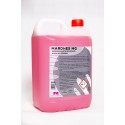
Mardhes Mg: the best degreaser for professional kitchens
Why kitchen degreasing is a cost problem, not a cleaning problem
In a working kitchen, grease is not just dirt. It is a film that traps dust, holds odours and slowly turns into a polymerised layer that no cloth will shift. By the time it is visible on an extractor hood, it is already costing you money in three places at once: labour hours spent scrubbing, chemical wasted on a job it was not strong enough to do, and a fire risk that grows quietly behind the filters.
That is the real reason professional kitchens buy a caustic degreaser and stripper rather than a supermarket spray. The product has to break down vegetable oils and fats and carbonised residue without turning a twenty-minute job into an hour of elbow grease. Mardhes Mg is built for exactly that job.
What Mardhes Mg actually is
Mardhes Mg is an alkaline degreaser, detergent and stripper for general professional use, aimed at kitchens, catering and food industry environments. Its formulation combines biodegradable surfactants, alkalis, sequestrants and bioalcohols.
Those four groups do different jobs and it is worth knowing which is which, because it explains where the product wins:
- Alkalis saponify fats. They turn grease into something water can carry away. This is why an alkaline product beats a neutral detergent on cooked-on oil.
- Surfactants lift the loosened grease off the surface and hold it in suspension so it does not simply re-deposit further down the wall.
- Sequestrants neutralise the minerals in hard water. In Spain, most of Madrid, Valencia and the coast sits on hard or very hard water, so this is not a minor detail: without sequestrants, hard-water salts react with the alkali and the working solution loses strength as you use it.
- Bioalcohols speed up penetration into carbonised and baked-on layers.

The dilution table: this is where the money is made
Most kitchens lose more money on a degreaser by over-diluting a heavy job than by buying the wrong brand. The product runs from neat up to 20% in water depending on the load, and choosing badly has a direct cost.
- Light load (daily wipe-down of tiled walls and preparation areas): low dilution, around 2 to 5%. You are maintaining a clean surface, not stripping one.
- Visible or tacky grease (extractor surrounds, splashbacks, splash zones): mid dilution, around 10 to 15%.
- Baked-on and carbonised grease (filters, griddle surrounds, oven interiors where the surface allows it): high dilution or neat.
The rule of thumb that saves the most money: raise the concentration before you raise the scrubbing time. Labour costs several times more per hour than concentrated chemical costs per litre. A kitchen that thins the product to save a few euros usually pays for it twenty times over in overtime.
Where to use it, and where not to
The product is intended for surfaces resistant to water and to alkali. Typical uses:
- Extractor hoods and grease filters, where the surface allows it.
- Tiles, washable walls and preparation zones.
- Surfaces with accumulated grease in a professional kitchen.
- Equipment and installations with heavy contamination from intensive use.
- Griddles, hotplates and cooking ranges (see Margras, the concentrated degreaser for griddles, for the dedicated plancha product).
Professional advice: on any delicate surface, test on a hidden area first. Alkaline products attack aluminium, bare or lacquered aluminium and some painted or varnished finishes. If in doubt, test, and never let the product dry on the surface.
How to apply it, step by step
The product does not work because it is strong. It works because of the protocol: concentration, dwell time, agitation, rinse. Skip one and you pay in scrubbing.
Step 1: dilute
- Light soil: start at low dilution.
- Visible or tacky grease: raise the concentration.
- Heavily baked-on grease: use high concentrations or neat, if the surface accepts it.
Step 2: apply
Apply by hand, trigger sprayer, spray or projection, depending on the area and the type of soil. Apply evenly and with control, especially on vertical surfaces, where over-wetting just means the product runs off before it has done any work.
Step 3: dwell
Leave it to act for 3 to 5 minutes. This is the step everyone rushes and it is the one that matters most. Without dwell time you scrub; with dwell time the grease releases by itself.
Step 4: agitate
Work the surface with a brush or cloth to help lift the grease film. On heavy soil, brief and effective agitation beats a long hard scrub, and it is far kinder to the surface and to the operator's shoulder.
Step 5: rinse
Rinse with clean water to remove residue. In food areas, always finish with a rinse: an alkaline film left on a preparation surface is both a hygiene problem and a food-safety one.
The three critical areas of a professional kitchen
Extractor hood and steel with stuck-on grease
- Apply with a trigger sprayer or pressure sprayer where the surface allows it, and allow 3 to 5 minutes of dwell.
- Agitate with a soft sponge or brush. Never use an aggressive scourer on stainless steel.
- Rinse and dry, working with the grain of the steel, to avoid water marks and micro-scratches.
Tiles and grout
- Use a medium dilution according to the soil load.
- Allow dwell time, then work the grout lines with a brush. Grout is where kitchen grease hides and where odours come from.
- Rinse thoroughly so no residue is left in the joints.
Surfaces with carbonised residue
- Increase the concentration if the soil is cooked on.
- Respect the dwell time.
- Repeat a second short pass rather than forcing the surface with an aggressive scourer. Two passes of chemistry cost less than one damaged surface.
Cost per working litre, not cost per bottle
The number that decides a kitchen's chemical spend is not the price of the can. It is the cost per litre of working solution: the price of the concentrate divided by the number of working litres it produces at the dilution you actually need.
A neat-only product has one working cost. A product that runs from 2% to neat has a working cost that changes by a factor of fifty depending on the job. That is the whole argument for buying a concentrated degreaser: one product covers the daily wipe-down and the quarterly strip-out, instead of one bottle for light jobs and another for heavy ones.
Two practical consequences:
- Buy the 5 litre format if the kitchen degreases daily. The cost per working litre falls sharply and the number of deliveries drops.
- Use a dosing pump rather than free-pouring. It is the only way to keep the dilution constant between operators and shifts, and it is where most of the wastage happens. See containers, sprayers and bottles for dosing and application equipment.
Safety and compliance in food areas
An alkaline degreaser is a professional chemical and should be treated as one. The points that matter in practice:
- PPE: gloves and eye protection as a minimum. Use the PPE specified on the safety data sheet, not what happens to be in the cupboard.
- Never decant into an unlabelled bottle. Spanish and EU rules on the labelling of decanted chemicals apply to the container, not the original packaging. If you decant, label.
- Chemical store: keep alkaline products separate from acids. Mixing the two in the same container releases heat and can release gas.
- Rinsing in food areas: always rinse and, where required by your HACCP plan, finish with a food-safe sanitiser. Degreasing and disinfecting are two different operations; see disinfectants for the second step.
- Data sheets: technical and safety data sheets must be available to staff who handle the product. Ask your supplier for the current version, in your language.
Frequently asked questions about Mardhes Mg
Can I use Mardhes Mg on any surface?
It is intended for surfaces resistant to water and alkali. Avoid aluminium and any delicate, painted or varnished finish. If you are unsure, test on a hidden area before treating the whole surface.
Is it environmentally responsible?
It contains biodegradable surfactants, which makes it a reasonable choice if you want a more sustainable approach without giving up performance. Note that biodegradability of the surfactant and the overall environmental impact of the product are not the same thing: see our guide on Ecolabel and UNE-ISO 16128 for the full comparison.
How should I dilute it?
Dilution depends on the soil load. It ranges from neat to 20% in water. Adjust according to the soil and the surface, and keep it consistent with a dosing pump.
Do I need special equipment to apply it?
No. It can be applied by hand, trigger sprayer, spray or projection. Choose the method according to the area and the job: trigger sprayer for verticals and hoods, projection or foam for large surfaces.
Can it be used in kitchens and food environments?
It is aimed at kitchens, restaurants and the food industry for removing vegetable fats effectively, always following the protocol and finishing with a rinse. It is a degreaser, not a sanitiser: if your HACCP plan requires disinfection, that is a separate step.
Does it work in hard water?
Yes. The sequestrants in the formulation are there precisely to keep performance in high-hardness water, which is the case across much of Spain. This is one of the differences you notice most against a basic neutral detergent.
How do I work out whether it is cheaper than what I use now?
Divide the price of the container by the number of working litres it produces at your usual dilution, then compare that figure against the same figure for the product you use now. See industrial degreasers to compare formats and concentrations across the range.
Why Mardhes Mg holds up against supermarket degreasers
If you are looking for the best kitchen degreaser on real performance, versatility of dilution and ease of application, Mardhes Mg stands out for its strength against vegetable fats, its flexibility of use (neat or down to 20% in water) and its performance even in hard water.
It is not a magic product and it does not replace method. Use it properly, with dwell time, agitation and a final rinse, and you will notice the difference on the first clean. For heavy engine and workshop grease, the same range includes Mardhes H50, an engine degreaser, and for general alkaline degreasing, Mardhes H70.
Buying in volume? Request a quote from the Mardhes Mg product page, or see how to buy, deliveries and secure payment for the commercial terms. For a wider view of the consumables a kitchen runs through, see how to clean an oven.
Share this content